Slow DatingSeason One

Reality Checks: Compatibility Patterns
The difference between attraction and compatibility.
Sadly for us all, attraction is not the same as compatibility.
Steph, in this episode
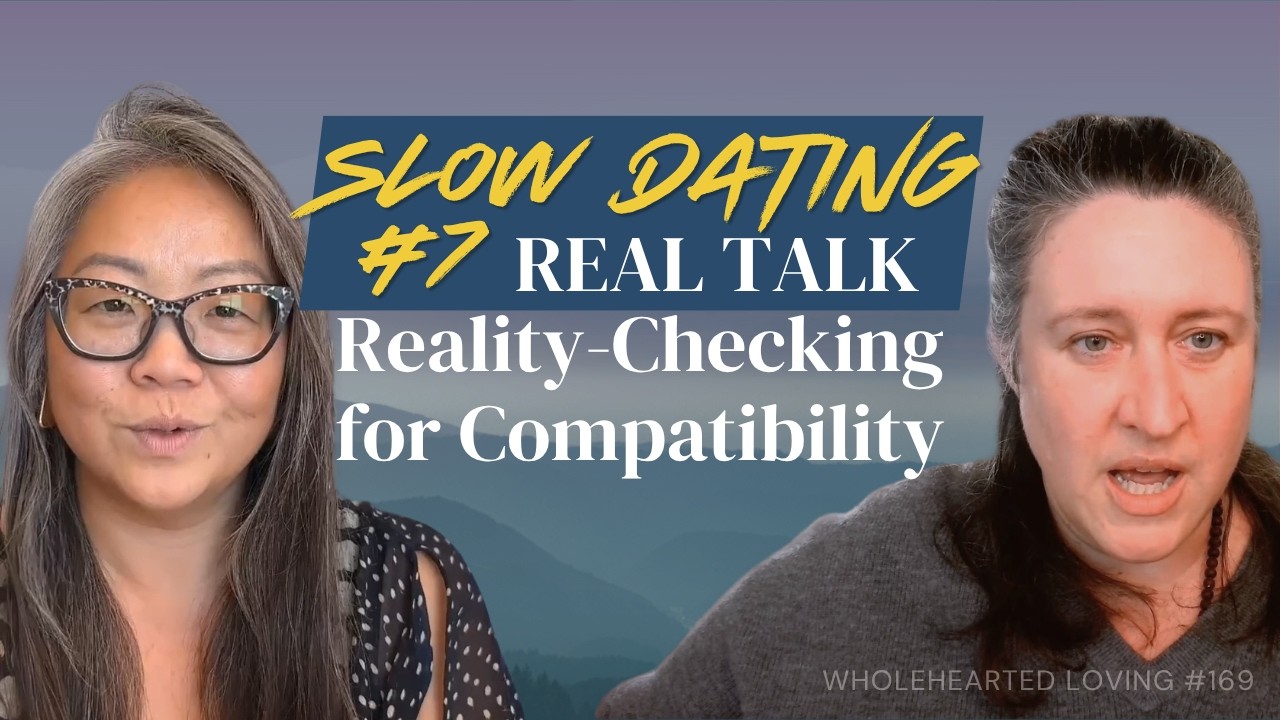
About this episode
You like them, they like you, the dates are going well — so how do you tell if your actual lives fit together? Steph and Georgianna dig into reality checking and lifestyle pacing: the honeymoon-phase codependent bubble that makes everything feel frictionless, and why that very ease can hide the long-term incompatibilities that matter most.
They walk through a long list of real-world patterns worth watching for — how someone treats a barista, their relationship with apologies and changed behavior, how they talk about exes and family, how they handle money, stress, plans, and conflict — and why the words people use (“flexible,” “loyal,” “reasonable”) can mean completely different things to different people until you get specific.
Along the way, Steph and Georgianna get candid about their own dating histories — underwear with holes, pooping with the door open, a literal spreadsheet of relationship grievances — to illustrate how old wounds and old programming can make familiar patterns feel like compatibility when they're not.
Stick around to the end for a playful, embodied practice — using your own underwear drawer — to help you feel the difference between a genuine yes, a genuine no, and the not-yet-sure that's worth taking your time with.
In this episode
- Why attraction and long-term compatibility are not the same thing
- The honeymoon-phase “codependent bubble” and what it can make you overlook
- Real-world patterns to notice: how someone treats strangers, apologizes, handles money and stress
- Why the same words (“flexible,” “loyal,” “reasonable”) can mean very different things to different people
- Collaborative vs. individualistic approaches to problems, and what that predicts
- The “price of admission”: knowing what you can genuinely accept vs. what breeds resentment
- Self-abandonment vs. genuine willingness to grow and change over time
- A practice using your underwear drawer to feel the difference between yes, no, and not yet
Full transcript Read +Hide −
Full transcript of Episode 7, “Reality Checks: Compatibility Patterns.” Steph and Georgianna, Wholehearted Loving.
So you met somebody, you like each other, you've been dating, and it's going pretty well. And now the question is do your lives actually fit together? Today we're going to be talking about reality checking and lifestyle pacing in dating.
And at the end of this episode, we're gonna walk you through a practice that helps you get more clarity about what it is that you really like and what it is that you don't like on a mind and a body level so that you know whether there's long-term compatibility with you and this special person.
Sadly for us all, attraction is not the same as compatibility. That initial spark that you felt on dates might be a lovely, pleasant thing, but it might also be transient. And this is what we're trying to figure out as we determine if you guys have long-term compatibility or not.
When we found someone we really like and they really like us, it's like this codependent bubble that blinds us a bit to the reality of things.
Yeah. They say that love is the greatest distraction and it truly is. And when you're dating someone to figure out if they're your person, it can't just be a fun distraction. We have to be really paying attention to what makes us compatible over the long term, where our patterns connect and where they don't.
We want to be enjoying. Like we don't want to miss out on the enjoying part. We want to enjoy and stay connected to what is really happening and remember that all of this takes time to reveal itself. So one thing that I mentally prepared myself for while I was at the beginning stages of my new relationship. I was so giddy. I was so happy. We wanted to spend all this time together. And I did myself a huge favor. What I told myself was.
There are so many things you love about this man right now, or that you really like about this person right now. Just prepare yourself that if this relationship continues, which I hoped it did, one day it will piss you off these things you really like about this man. And sure enough, they did. And it doesn't mean I was wrong about this person or they were deceiving me. It's just that things are shinier at the beginning.
We skews a lot more. We go with the flow a lot more. We give a lot more grace and we want to let things play out and see what happens.
I've had this where I'm like, this thing that I think is so cute right now, I I'm pretty sure this is gonna drive me insane in about two years and then fast forward two years, I'm like, There's that thing. I knew it, and here it is.
Mm-hmm. When that happened, because it happened for me, I would tell myself, you loved this about this person before. And I didn't tell myself that to take away the part that I didn't like, but it was to put it in context. Often, like the thing we like about someone means that they're really good at that one thing. And it means that they're probably a little bit less good at this other thing. You realize later you also want them to be good at.
So enjoy it and be aware. Part of the reason this codependent bubble in the honeymoon phase feels so good is because there is no friction. You're accepting everything, you're noticing everything, you're paying attention, you're giving each other a lot of attention. those are wonderful grounds for beautiful love to flourish and also danger for you to ignore.
flags or to bypass things that are actually really important to you because you're enjoying that snugly love feeling when you might also be noticing that this might be a sign of incompatibility for the long haul.
In episode 10 of the series, we're gonna walk you through the four phases of relationship. We've mostly talked to you about the honeymoon phase so far, the part that feels really fun and special, and the part that most of us really like the most. But there's also the power struggle phase. And then the dead zone, which I have been in several of my relationships. And then conscious relationship. What you get to
co-create together when you practice these skills that we've been talking to you about over the course of this series. You're going to want to hang around for that episode because we tend to have a preference for certain phases of relationship and get stuck in some of them and hop from person to person and repeat certain phases that we have either comfort in or familiarity with. And we think that that's all that's available to us. And it's not.
There's something different available to us if that's what we want. But you want to know what the phases are, what the signs are of each one and how to know when you're stuck and how to know how to get out of
So notice where you are right now in this dating relationship that maybe you're enjoying while you're on this journey with us on the podcast. If you're in a honeymoon phase, notice what's happening there, enjoy the intoxication and recognize that you're at a moment in time that's going to change and you've got the power to pay attention to where you're at throughout.
And to make choices at every step. You might look back on old relationships and notice these patterns that you found so intoxicating. And this time, with these new tools that we're giving you, we're going to choose a different way, something more conscious, more on purpose, and more regulated.
And more fulfilling. Ultimately more fulfilling. Isn't that what we want?
Yes. Yes, it is. So all relationships start with information sharing. Either information we're giving, information we're demonstrating and showing. There are many patterns that will only appear over time, or it'll only be clear that they are in fact a pattern over time. In this dating phase, people are gonna tell us all sorts of the ways that they are and what they value and what they prioritize. And if you've been pacing, you've started gathering a bit of information about what's actually
True, how this person actually lives, what they give energy and attention to in their day-to-day life. So we're gonna get a little bit deeper into patterns that are important for you to start noticing in real time. See if you've got long-term compatibility. It's deeper than just do I like that and do I not like that. It's how does this gibe with my lifestyle?
Let's talk about the barista. How someone tells you they want to treat people. I really am a polite, kind, compassionate person. And then you witness them in real life and you notice how they speak to people like the barista, and you realize, actually, that doesn't sound very kind or compassionate. there's a mismatch here between what this person says they are and believes maybe that they are, and how they actually behave in real
Mm-hmm. Yes, that makes me think also of phone usage. You know, you wonder why aren't they texting me back? And then you think, well, they're on their phone all the time, so they are getting my texts, or you notice in real time they're not on their phone all the time, their phone is always away. Some others that come to mind immediately, high-level patterns we tend to look for in relationship compatibility are financial stuff and apologies and changed behavior. You want to say a bit about that?
So some people suck at apologizing. That's one category. But we here we're talking about the people who are willing to apologize. And what you want to be looking for is does this person who's apologizing also show the willingness and capacity to actually change their behavior? Do they actually do things differently? Because if they don't, then it's all just words and fluff. That was something that I really had to look for. And what I realized is if this matters to me, I need to look for a person.
Who is willing to grow a new skill? Because generally that's what changed behavior means. It means this person will use a new skill set, a different skill set than they tend to fall back on. And do they actually do that? And then my next question I like to ask myself is: am I seeing the signs that they are putting in effort to build this new skill?
Mm-hmm. The saying is the way you do one thing is the way you do all of them. So the way somebody talks about, you know, the shitty thing that happened at work is gonna give you a lot of information about how they deal with feeling like they're under attack or like they need to be changing in some way or apologizing for something and how they're gonna handle that interpersonally and with themselves. I think one of the traps we fall into is noticing how the person is with us.
and assuming that's the threshold, that's the exemplar behavior. But you can actually observe what they're doing with every relationship and interaction around them and deduce from that how things will end up going with you later down the line when you just become run of the mill partner who's around every day.
The way someone talks tells us a lot about their mindset, how they see the world, what they find important. And of course, we're talking about pay attention to how someone talks and pay attention to how someone behaves. But I think there's a lot of time where it's very easy to dismiss the way people talk about things and people and exes and mothers and jobs.
But I really like to pay attention because I feel like they tell me a lot about this person and how they're wired.
Mm-hmm. Even when I think back to my own stories, like I had a weird, bad breakup many years ago, and the way I spoke about it many years ago, and the way I thought about it is very different than the way I think about it and speak about it today. You know, and that's because my internal landscape has changed. So everything we speak is a reflection of what's happening inside of us. And these are in part the patterns that we want you guys to notice with these
folks that you're dating.
I really noticed that growing up the way my dad would approach when things didn't go well was to get really flustered immediately and find something or someone to blame. When I watched his relationship with my mom, I saw, that pattern plays out in how he speaks to and about her as well.
Mm-hmm.
Like I love my dad, he's a sweet man, but these are his patterns. These were his patterns, right? Like if the screwdriver fell off the table, he'd have a certain reaction. And that's also the kind of reaction that I'd see interpersonally between him and my mom.
You're reminding me of a pattern I have of flaming that I didn't realize I had until I lived alone. And I can't
They are inanimate objects?
No, I I can't I think it was that I'd left something somewhere or i something that was in my way and my first thought was, Who put that there? It was exclusively myself. You
It was only you. And like, I'm not throwing my dad under the bus. I just want to humanize this, right? Like I do it too. I find that in myself. And I find that in myself a lot more in the past. I would outwardly look for somebody or something or some circumstance to blame. I'd either do that or I'd blame myself. There was no neutral in the middle. There was no, that sucks. I think I want to do that differently next time. I think this would be what would help me approach that differently next time.
Right. It would be I suck or they suck and I have to make them feel crappy or have to make myself feel crappy. Those those are the only two options. But as I grew my self-compassion muscle to say, hey, yeah, like that's real, that sucked, that's hard. And you were responsible for it, and that's okay. And there's a different way we can approach it next time that will be probably work out the for the best or better. Now I approach other things and other people.
from that same energy. Right. If someone messes something up, I'm like, okay, yeah, you messed it up. That's okay. How do you want to deal with this next time? How do we, you know, try to ensure this doesn't happen again? And I'm genuine in that energy. I'm genuine in those words. There might have been a time where I tried to say those words because we're told like that is good conflict resolution. But I didn't really believe them or feel them.
Yeah. Yeah. So what you're describing there is the internal pattern and then the externalizing of that pattern. It makes me realize that the external pattern shift that has happened for me, like with this blaming and this mystery object that I put in my own way. My old pattern would have been to continue the irritation afterwards. After I'd noticed while I'm blaming someone else for something that I've done.
And I needed to grow that muscle.
I would have gone deeper down the spiral of that irritation. Whereas now the pattern has shifted to, I noticed that and I can laugh at myself. This is a wonderful pattern to notice. And one of my favorite patterns to notice about people is if they're available for a laugh when something has happened, or if they're gonna go further, deeper down that spiral of shame and blame or whatever it is. Key pattern noticing.
When you're listening to Steph and I talk about our personal patterns, the theme you're gonna notice is we're very connected to them. We're very connected and aware of our old patterns, our current patterns, and the patterns we're trying to grow right now. And I didn't always live like that. And I don't think Steph, I don't think you always live like that, but we decided at some point if I want to have a better life and better feeling relationships.
I need to take ownership of my patterns. I need to know what my patterns are without shame and blame. And that's the thing we're encouraging you to practice is notice your own patterns and begin to notice someone else's patterns of how they show up. And I'm gonna put this out there. You don't have to agree with this or choose your partner based on this. But for me personally, the more you choose someone.
Who has some awareness of their patterns and has a willingness to grow new muscles to shift into more constructive patterns, the more likely you're gonna have a fulfilling relationship.
Definitely. So openness right there feels like a huge piece. and we've got this list that I think we should go through out loud, but I think a piece that is not on it is openness and receptivity. What's their pattern when you point something out? Are they open? Are they available for a laugh about it? Do they take it personally? Do they hide? Do they attack?
Are they curious, right? Like even if they initially don't know what you mean, is this a person willing to be curious? Do they ask you, what do you mean by that? Help me understand you better? Or do they take the fact that they don't understand you and make a judgment about you or themselves?
Mm-hmm. Yeah. Okay. We're gonna get into some nuanced things that I think will be very helpful because people have got this list of things. You want to make sure you're compatible. You've got this checklist. Do we want kids? How do we deal with finances? And I think, especially with the finances one, people might take it to a level of like, are they open and willing to share their finances? The end. That is not the end. There is so much more information there. When we were planning this episode, I was talking about.
Some of the sort of assumptions we make. We've talked about the meaning maker, the ego, the sense-making capacity our brains always are operating under. So right now we're talking about reality pacing. You're going to be noticing behaviors and you are going to be unconsciously slotting them into categories that make sense in your mind. This is part of what we want you to be checking. So if you've got a partner who's, you know, willing to talk about finances, great. Don't leave it there.
notice I think the example I gave was they buy a matcha at Starbucks every morning. Meaning maker will assume they can afford that. Maybe they can, maybe they can't. We don't know unless we've talked about it. The important key is noticing that pattern is occurring. What am I making it mean?
And this applies to all those other areas. Right now we're talking about finances, but it could be health, it could be friendships, it could be career and education. You wanna know in these major pillars in life what your beliefs are about these things and also whether our actions match our beliefs. You're gonna wanna know that about this person. And they hopefully are gonna wanna know that about you.
Mm-hmm. And the here we're back to the self-knowledge being so important. You know, if somebody says, well, it's very important that I save twenty percent of my paychecks, that might sound like good information. But then if some special thing comes up, your girlfriend's fortieth birthday in Ibiza and in your financial framework, you can dip into that twenty percent.
And for your partner, they're like, Absolutely not, that's a hard line. These are important things to know in advance. Do we mean the same things? Are our meaning makers meaning the same things? And getting really explicit.
It. We use the same words. They don't always mean the same things. So we really want to encourage you to get down to the nitty-gritty with this person in a light, playful way, because things don't have to be so serious. But like make sure you're actually talking about the same thing. And I think for all of us, it's easy to fall into that trap of, well, we use the same words. We must mean the same thing. But you might not. And that would be good to know. Another thing I think that Steph, what you said, made me think of is.
What is this person's relationship with rigidity and flexibility? And does that match what you're interested in or not? And perhaps there's certain areas in their life they're more rigid in or flexible in. And this applies to ourselves as well, right? But you want to know that about yourself. You want to know that about this person, right? One person is super rigid about most things, and one person is super flexible about most things. It could either absolutely not work.
Or the flexible one could just, you know, cater and cater and cater until they realize actually this sucks and I've hated it all along. And then you wonder what just happened.
Mm-hmm. Right. And what a great illustration of words don't matter here. It has to be experienced over time. Because our meaning of the word rigid and flexible will be completely different. I'm thinking about a a wonderful OCD person I know who believes themselves to be reasonable. It's such a subjective word. What does it mean? We don't know. And in the context of having OCD for cleanliness things.
What is reasonable? We just don't know what that means. We can only observe over time and feel into if it's a fit.
This is where that we return to self-knowing. If you're telling someone, I want you to be flexible or I am flexible or I am rigid or I am reasonable or I want you to be reasonable, what does that mean in the context of this particular moment in regards to this topic? You want to be able to articulate that and explain that to someone. And the only way we can explain that to someone is if we know it for ourselves.
That's right. Yeah. There is an example from my beloved ninety-day fiance that I will give you now. There is a couple. They're on the rocks. I think actually now I know from advance information on Reddit that they have in fact broken up, which is a good thing. But they were on the rocks because she started up an OnlyFans. He is not okay with that. They're trying to compromise. All of the therapists, everyone is saying this is just a matter of compromise.
And what he's saying is, I can only stay in this relationship if you stop doing X, Y, and Z. Very clear. She's swimming around in these waters of compromise being possible. All the therapists are just referring to compromise, this vague word. What does it mean? And the only person who's had any clarity is this guy saying, This is my hard line. And everyone just dances around it with words.
Prompts that we often give people when it comes to things like this is something I'm open to is and something I'm not open to is. Because that gets you really succinct and clear. Yeah. Right. And this is not a prompt you answer with one thing. You repeat that prompt over and over again on both sides, what you're open to, what you're not open to, what you're willing to do, what you're not willing to do, until it becomes crystal clear to each person what's on the table, what's on offer, and what's not.
This is not meant to put pressure on you or make you feel like you cannot enter a relationship or you won't be a good partner unless you know all the things about yourself and all the patterns you like and all the ones you don't. What this is about is: can you recognize in the moment when you are aware of something that's true for you and when you are confused and need more time? When you do not know the answer of what your preference is, are you able to say?
Hey, I realize I'm not actually really sure what I'm asking you for. I'm not actually sure what I'm complaining to you about right now. I think I need a minute or I need some time to reflect on that. Or would it be okay if I just talk this through with you to come to some more clarity? Right. So it's not about having to know it on the spot. It's about recognizing I know it or I don't know it. And then what are we going to do about it? Not making someone have to figure it out for us.
Yeah.
Because I really like to do that before. You should know what I mean. I'm upset. You should know what I need. You should know what I didn't like about that.
Yeah. Well, and that's a really useful pattern to notice, right? A people pleaser will be attracted to this person who cannot be pleased because they don't know themselves, right? So then you end up with one party constantly moving towards the other, trying to help, and the other party n backing away, not knowing how how can you help me? I just don't know. So great pattern to notice if you're with someone who needs help, wants help, can't be helped, doesn't know how to be helped, useful to know.
Then to notice your own patterns in response to that. So let's have a look at your lovely list here. How people treat their body. That's a useful pattern to notice. I remember once getting a message from a man on a dating app who was a big boy. I like big boys. His message was a whole qualifier about his existence. Like he's like, hey, you know, would really love to get to know you.
Just want you to know I'm currently overweight and you know I have all these plans for how I'm gonna not be overweight. Okay, glad you've got plans in your life and intentions, or maybe you're just saying words. What do I
That includes a self rejection and a promise to change. So it's just like a whole whole bunch of unknowns right off the bat.
This one touches deep. I remember when I entered into my current relationship, I was the heaviest I've ever been in my life. Not super comfortable with it because it just physically didn't feel good. But what was cool was I wasn't self-shamy about it, which was a strong pattern in my life when it comes to my body. And when I hear you talk about that example, I could see old parts of myself. I might not have declared that on a first date or like on a profile or a first message.
But I would have found a sneaky way to insert that into the conversation, to make it known to the other person, like this is not my ideal and this is not my how you know how I really am or how I really want to live. And there's nothing wrong with that. If you want to communicate to someone where you're going in life and what your plans are, that's fine. That's great. This is about the energy that it's coming from. For me, it would have come from this energy of, God, I hope you're not judging me. And like,
I hope that if I explain this well enough that you'll give me a chance. And I remember this time around, I said none of those things. I was like, I'm just gonna enjoy this connection. And if this dude is bothered by that, I will find out soon enough. He wasn't bothered by it. And what's really cool is, you know, when we're looking at patterns, I really feel like this has made a big difference for me in healing my own relationship with my body is to be with someone who's
super comfortable with theirs, like super comfortable with every human thing that bodies do, the shapes that they take, the fluctuations that happen. And I get to watch I'm like, wow, I want to live like that. I can live like that. I really enjoy being in a relationship with someone who speaks about their body and people's bodies in that way. Yes. Right. And I'm not saying this is someone who was like talking about people's bodies all the time, but you can tell
by how they live, what their beliefs are about body image and what physical form we should or shouldn't be in. I was like, this feels very nice, right? Whereas I remember dating someone who's like, are you gonna go to the gym today? You haven't gone to the gym in a while. Or are you gonna eat that? I'm not gonna eat that. You think you should eat that?
Yeah, not fun for anybody. I know what you mean. And I mean I guess that is fun for some people. Some people like to live on the shame train, and I don't. I don't like to live on the hypervigilant scrutineer wagon. That's not fun for me.
Yeah.
Yeah. Could we could we talk about poop for a minute? I don't think we've talked about poop a single time this entire season. Amazing. Old pattern, poop related, meeting a man, being like, Well, if we live together, how I'll have to find a public toilet nearby to poop in so that he never knows
Let's talk about poop. What do you
Obviously. Obviously. Because you're so beautiful, you're so stunning, you're so lovely, you can possibly ever need to poop.
You definitely don't need to poop. So I mean, notice your patterns around poop, I guess. It's wonderful to be with a man. So the last guy I was in a long term relationship with, I was lying in bed, literally thinking, Where am I gonna poop tomorrow? And he just got up and pooped with the door open. And I was like, okay, f first of all, l complex layers here, okay? First of all, I don't want you to do that. Close the door. But I didn't know that.
Because at the time I was so consumed with my own fear of being known as a pooper that all I could think of was amazing. I don't need to be afraid to poop. Good lord. All of this is true. This actually all happened to me. And so at no point did I ever think or say or act upon the fact that I don't want poop just to be a freewheeling around the house, you know, like let's maintain a bit of some kind of poop privacy.
So interesting to notice, interesting internal patterns. And this reminds me, I've got a friend who told me about a pooper in his neighborhood. And I immediately wrote a story about this. So he would wake up in the morning to walk his dog at 6 a.m. and there'd be this horrible smell of poop in the alleyway behind his house. And one day he saw who it was. It was a tiny yoga girl out for a jog, suddenly deques off to have a little poop behind his garage. And in that moment, I was like,
This lady has a new boyfriend and she doesn't want to poop at his house, so she pretends she's going for a jog, for heaven's sake. Yeah.
Boy. This reminds me of so it's not just poops, it's farts too.
yeah, yeah, yeah. Never let those out. Right.
I remember I remember there was some lady who had to be taken to the emergency because she had all this abdominal pain. And in the end I think the doctor said to her, like, you've been holding your poops in and that's what or not your poops in, your farts in. Yeah. This is what's causing all this pain for you. And it just saddens me and I can see the humor in it and I get why we fall into this pattern.
And I just say, you know, find someone where you feel free to poop and fart and be human around.
Yeah. This is super important. Or, okay, now bear with me here, it might be the opposite. So say you're from a family of we don't fart out loud people and we like mock people who do or we shame people who do. If you partner with somebody who is a lift up the butt cheek fart at the dinner table, the whole family laughs, this might not be a pattern match. You know.
Alignment. We're looking for alignment. And alignment is specific to you and which phase of life you're in, which season of life, who you are now, right?
Yeah.
Yeah. Yeah. Yeah. That's right. Okay. Thank you. Small poop diversion. Obviously was important. next on the list here we have keeping or breaking plans.
Hmm. Now this is interesting. This shows you how our old wounding can play into this. I remember just being so excited to possibly be chosen by someone that the fact that they made plans with me was enough for me to like them and fall in love with them and think they're absolutely amazing. What I didn't pay attention to was when they always break those plans and break those plans at the last minute and also then don't initiate making new plans.
And I was so caught up in being chosen that I wouldn't let myself feel the yuckiness that that feels like to be with someone that just never feels reliable. Right. You can't count on whether there's follow through. There's different things you want to experience someone's reliability in and follow through in. But in terms of just spending time together, I mean, if you can't rely on that, how do you build the relationship? How do you collect the data and experience the person to even see if there's
alignment over time. So that's something that I really had to pay attention to. Can I count on this person to do what they say, to show up, right? To make plans, keep their plans, schedule new plans.
There's a super important piece there when it comes to knowing ourselves and what we need for the long term. Cause in friendships and in other relationships, there's degrees of trust that are totally acceptable. You know, I've got friends who I might trust them to save my life, but I might also trust them to consistently cancel plans or to bail at the last minute. And that's a type of trust. Like, I can trust this person to cancel these plans. I can trust that I will get a nice night.
home on my own and these plans won't actually go ahead. That might be suitable in that relationship, but if it's someone who I'm gonna be co piloting my entire life with, that would not work for me.
Right. And what we're talking about here is not that there's one blanket way that is the right way for a human or a potential partner to behave. If you really don't care if someone is flaky last minute, and maybe that even gives you permission to do the same, and that feels like freedom and flexibility to you, then you might really be aligned for each other in that department. But if you're
Pretending you don't care. You're pretending it doesn't hurt your feelings. You're pretending you can live with it. You're just looking forward to the next time that maybe it will work out. That's something to pay attention to.
Yeah, for sure. This is making me also think of our pendulum swinging from one thing to the opposite thing. So notice, especially if you're in a new relationship, are you just escaping a previous pattern by choosing the opposite, you know? and don't let that be the bar. We're we're looking at what really feels good to you, not just what's the opposite of what didn't feel good to you. There's gonna be a lot of nuance within.
Or what we hear often is, I don't believe that I can have that experience. Right? So if you don't believe it, that's okay. This is not about shaming you for that. But recognize that that is in the way. That is one of the factors at play right now. Right. And this is a separate thing from, well, if anything in the world could happen, what do you think would feel best for?
Mm-hmm.
for you? How do you want someone to follow through with plans? Right. Does it matter? Does it absolutely not matter? Let's put separate as an aside what you believe is possible for you. Right? Because there's separate issues.
Yeah, love that. Okay. I think this one is obvious. We've probably even already talked about it here, but how they speak about their exes and their mother, how they speak about other people generally.
I like to pay attention to is someone a blamey person? Because there's a difference in speaking about how someone behaved while you're in relationship with them and the impact it had on you, and perhaps even your preference of how they would have handled something and trashing them, right? And there's a difference in being able to say, and I can see that this was my part of that dance, or I can see that.
Putting up with that for so long was my responsibility. And I can also understand why I did that. Where, you know, is someone just about blame and laying all the blame outward and speaking purely negatively about people. That will tell you a lot generally about how they walk through life.
Totally. So I think it's important here to talk about I'm gonna call it the joy of hatred. Yes. And I don't actually know if you've got any of this, but I have a fair amount of this. I love hating certain things. I love bitching about certain things, but underneath that is very much self awareness and a great love for humanity. There are people who want to bitch and hate on things and that there's no underpinning love of humanity under that. So
Yeah.
That's an important piece to notice too with patterns. I think the show Seinfeld was popular because they were assholes and it was a show for people who like to be assholes. This is a common thing, right? We love to externalize some of existential angst and difficulty by pointing it out at the world and blah, blah, you know, hate all this, hate all that. And that can be fun, but notice what's underneath it. And notice, you know, if I was getting together with someone, like I can be beautiful friends with Georgiana.
But I don't know if we could be lovers 'cause when would we ever hate on the world together in a loving way, you know?
Yeah, that's probably not something I want to spend time doing. I think this is the key here is the surface is just the surface. So if I was to hang out with Steph and I'm listening to you rant about something, if I don't get more curious, I wouldn't know that there's this other part of you underneath all that and this understanding of reality that's underneath all that. And that might be important.
Yeah. Yeah.
For me to know about you because maybe when I see that bigger picture, I'm like, I do like this person. Or it could be, I don't actually care if there's more to this. The fact that this person likes to verbally, outwardly, you know, lash out and talk about their disgust and hate for XYZ is enough for me to say, I'm not interested in that. I don't want any part of that in my life. And that's fine too, but it's just that we don't know when.
We don't get curious.
Yeah, indeed. We make meaning out of our past experiences and plunk it onto the current thing. So getting curious, definitely important. Repair after conflict. How do they repair? How do they not? I'm reminded of I know a woman who keeps an actual log of everything that's ever been done wrong to her and she reviews it annually.
Hey, I wonder if they knew my ex Don't you remember that there was a spreadsheet made about me?
yeah. The spreadsheet.
Yeah, every every fight we ever had was documented in a spreadsheet with the date and maybe the themes of what I said or what I did that they were not happy with. And they were very excited to share this spreadsheet with me. I value clear communication and being honest with each other.
And you like spreadsheets?
I do like spreadsheets, but there was and again we talk about this, there was an energy behind it that wasn't like, hey, there's this unresolved thing I'd really love us to chat through together so we understand each other better. It was, I want to take you to court and I want to present my case about how you were super wrong about this. And like, dude, yeah, no, that's not cool. And then because this was former self in this relationship.
Yeah.
Yeah.
Because I was so happy that finally someone wanted to repair through conflict. I was like, yay, this person actually wants to repair through conflict. And yay, I feel comfortable enough with this person that I can actually show my upset and my anger, which I had always been the people pleaser and never really showed it. So so happy about those two things that, like you with the pooping with the door wide open, I didn't register or I didn't give it enough weight that
I don't want to feel like I'm on trial. So what I did was I sort of minimized that part and laughed it off and like just focused on, but this person wants to talk about what went wrong. But what happens, because time happens, is it became apparent that there's a score-keeping element here. There's a I'm gonna keep this and throw this out at you later feeling. Like, yeah, I'm not into that.
Yeah. No, definitely not into that. If you've grown up being on trial and constantly having to defend yourself, that pattern might feel familiar and you might confuse it with how you want to live or with long-term compatibility. And this is where we'll ask you to pause and feel into what's actually good for you. What your body says is a yes versus what your body says is familiar.
Here's what gets confusing. We're just talking in our relationship lab call of like, there's no black and white, right and wrong all the time. Because if you did grow up where you felt like you were always on trial and you had to defend yourself, anybody with the best of intentions that just wants to let you know that something that you did did not feel good for them can feel like they are putting you on trial. And it might not necessarily be that.
We really gotta pay attention.
Yeah. Slow down. Yeah. Yeah. Let me look at this list here. There's so many examples we could give here, but let's wrap up this portion by talking about this a pattern of attention or dismissal. that can be with other people, it can be with our our feelings, our endeavors in life, our joy. What do you want to say about that?
When you talk about where they place their attention, it reminds me of the bids for connection. Like when I am sharing something, I want you to know about me, whether it's I'm excited or my feelings are hurt. Do you move further away from me or do you come closer? And by that I mean do you come closer with interest and you want to be in it with me? Or you either want to escape it, you want to make me wrong, you want to minimize it, you want to make me feel bad about it.
That's something for me personally, I'd be looking at that kind of pattern.
Mm-hmm. How they handle stress.
For sure.
Your stress or their own stress.
Yes. And here's the thing, whether someone, and including yourself, does stress excuse poor disrespectful behavior. For some people, it's a free pass in some relationships. And for me, I don't want it to be. I don't always manage to live up to that. But I want that that to be our relationship vision, that being stressed is not a free pass to be mean or rude or disrespectful. Right.
And for me, included in that is do we call each other names? There's many people totally fine with that. Do we degrade each other? Do we shame each other out loud? I don't want to be in that kind of relationship for so for us, it's like a no-go place. But I've been in relationships where that's a okay, we can go there. We can go there sometimes. We can go there if we apologize. Right. And I know for some people it's we just live sort of there.
And it's the normal way we interact with each other. And if that is truly, truly, truly fine and okay and good feeling for the both of you, excellent. There's your alignment. But if it's not for at least one person, that's something important to look at. Yeah. Something I learned the hard way was to pay attention to whether someone takes a collaborative approach to relationship or a very individualistic approach. Are they caring about your mutual well being or they're more concerned with either yours or theirs on their own?
Do they like to solve problems together and be a team and a unit and create that feeling that you both have that we're on the same side? Or do they prefer to be like, yeah, we're fine until we disagree and then I see you as the enemy? Right?
Mm. It's a big one. This is an interesting one because for me, I've got this strange combination of both. If I've got a problem, only is it new to me to occur to me that anybody would want to be helpful with my problems. Like that's not part of my natural programming. I'm fixing it on my own. But if you articulate that you've got a problem, my assumption is that it's all hands on deck to solve this problem that we as a team now have.
Good pattern to notice. Pattern to notice, right? And where this really bit me in the butt in past relationship was I was in this relationship. I thought it was going well. And then all of a sudden you hear out of nowhere, apparently it needs to end with no real answers. And I'm sure a lot of people have experienced that before and you're just utterly confused. One other pattern was I had to dig for information. It was never forthcoming.
So to work really hard to pull teeth essentially to understand what is going on, what happened here. I thought we were good. Eventually I got pieces of information that gave me a sense of what their concerns were. And I thought to myself, and then I said it out loud, I'm like, what a shame that you didn't come to me with that as a concern, because I could have told you that that's actually not an issue. And then for this other piece, we could have worked it out together.
Right.
It made me realize I do not want to be in relationship with someone who makes unilateral decisions on that level for us.
Yeah. Yeah. Whereas I guess there's some people who would be really happy to never have to make a decision. Exactly. And we would love that, you know? Yeah. Yeah.
So you really just gotta be truthful and know yourself.
Yeah. Okay, the loyalty piece. I'm sure I've got some out there story. That's not gonna be exactly what you were getting at.
No.
All right.
So from my innocent worldview, loyalty meant things like we don't cheat on each other, we consider each other in decision making, we say nice things about each other when we're not around. To this guy I was dating, loyalty had a lot of really intense connotations because he'd come from a a broken home where there was a threat of the kids being taken. Like it was this really intense, dramatic
Loyalty that made sense in his worldview. So I remember the way this came up. I was like, I don't think this is, we're not compatible. We're going to get life insurance. And he's like, don't tell them I do cocaine. I was like, okay, wait a minute. First of all, not compatible. And also, there's just no point lying to a life insurance person about something that might kill you and make
The life insurance moot, you know, like why don't we just cancel this appointment? Meanwhile, he's saying you're gonna be just like my last girlfriend who told the life insurance guy that I did cocaine. And that's where his loyalty threshold was. If I wasn't prepared to make this pointless wild lie, then I wasn't loyal.
Great example of how words mean different things to different people. And the context is important. And you want to get down to the nitty-gritty of what that actually means. When we were talking about loyalty, my mind went somewhere different, other than lying to insurance agents. Because I hear this a lot from people about, but I want so badly for someone to stick it out with me through the hard things. So I feel like if I want that from somebody,
Yeah.
I have to do the same. Okay. I think it's great to value, generally speaking, that we ride the waves together. Once we've found someone that we're like, there's some alignment here. We're going to go through life together. Life brings ups and downs. We're going to do life's ups and downs together. That can be a really healthy outlook and approach for relationships.
The problem is when we pair loyalty with I am no longer connected to reality and whether there's actually alignment here. Because then you stay loyal to a relationship, to a person where we actually don't match, our values don't match, how we live doesn't match, but I am so concerned with being loyal, I will stay. And then you wonder why you're depressed or you're feeling unfulfilled or there's all this tension and conflict in your relationship.
Yeah.
Right. And I feel like if you pair loyalty, whatever you make that mean, of course. I'm just meaning just sticking it out and working through life's ups and downs together with alignment. You're gonna probably end up with a better experience. So you wanna pay attention to that pattern of whether someone also thinks, Well, we signed up to be together. Now we have to put up with each other's most worst behavior, no questions asked. That's another pattern. Some people think that's true.
When we really want something to work, we can find ourselves falling into that trap of subconsciously trying to force our partner to be different, to be a different person, so that maybe if they're different, this relationship can actually work out. And that's not what this is all about. This is about really slowing down and noticing how you show up in relationship and how your partner shows up in relationship. And is it something you want to sign up for? Is it something you are willing to pay the price of admission for?
They are not wrong for who they are. You are not wrong for who you are. It's just, do you mutually choose each other? I like to think of it as a contract. I'll talk to people and we'll talk about the relationship or situationship they're in. I say, imagine someone slid a contract in front of you and it said, I'm rarely gonna show up when I say I'm gonna show up. When you feel sad, I'm gonna make you feel like crap for it. But occasionally I'm gonna take you on really lovely trips and we're gonna have a great time.
That's on the contract. Are you like, give me the contract? I'm signing it right now. I want this. Sign me up for it. This is what it's about, right? So there's something on offer for you. Just like you're putting something on offer for someone else and you're each deciding, am I signing that contract? Do I want to sign up for this?
So pooping with the door open and like doing blow off a Cadillac with prostitutes. That's on the contract. Yeah, no, no. I would like to renegotiate the terms, please.
In front of you.
Yes. And here's the other contract, right? Which someone could say, okay, Stephanie, I'm gonna pull that one away from you. I'm gonna slide this one to you. And this is the one that usually s freaks people out. Are you willing to be single for a while while you wait for someone more aligned to show up?
And you're like, throw that one out too. Not willing to do that one. And you know, and maybe you're like, actually, can you take that one out of the shredder, bring it back, tape it back together for me? 'Cause maybe I'll take this one instead of being single.
Right. You know what actually came up in my body when you took the first contract away was a wash of relief. And then when you came in with the new contract, I was already backing away. I was like, I'm not ready to look at any more contracts right now. Thank
But that's also a good notice thing. Yes. I'm not ready to consider anything else right now. I just need some time. Right? But ultimately we're always signing some contract. Steph's you're essentially saying, Give me the contract that says I have to make zero decisions right now. I'll sign that one.
Yeah, yeah.
Yes, I will. Done and done. In pen.
So we are always choosing something. But you want to be conscious about what it is you're choosing.
That's right. Yeah, the price of admission. This is not just about their patterns for you, it's about your patterns for them. And inevitably, there are going to be some patterns that do not perfectly match. And what you have there, this difference, this gap, is what we call the price of admission. Is it a price that you're willing to pay? For me, it would be a no-brainer if the drop zone at Playland was five dollars, but if it's $25,
I'm not sure if I'm signing up, you know?
And for me I feel like you couldn't pay me enough to go on it. I mean, no, that's not true. Maybe if you offered me like a million bucks. But I don't think that anyone's coming by with that offer anytime soon.
So what's the price, you know, and that's the kind of this is a good example. It's a silly example, but it's good. If you were given that million bucks, this is the difference between like if you were given 20 bucks, you might, you know, force yourself or go on that drop zone ride with some resentment or letting fear really run the show. But if you were given a million bucks, you might even be able to muster some enthusiasm for it, right? So when we're talking about the
price of admission. It's not what am I grudgingly willing to put up with. It's what do I genuinely want to pay? What am I genuinely willing to change or forego or compromise on where I can actually be happy and not resentful?
Exactly. We that's what we're going for. The energy of what's the opposite of resentful? Happy? Content? Fulfilled. Let's aim to be in relationships with people where resentment is not the most familiar state and energy we live in.
Yeah. And I you know, I guess I have to say there's gonna be some people who want to live there and that's where they naturally are. I remember a a couple on this ridiculous show called Little Brit and the skit was the they would go out for dinner or to sit watching a a beautiful vista from their car and they just sit there quietly and as the viewer you're kind of imagining, this cute old couple sitting together enjoying a nice dinner, whatever it is and then the whole skit is that one of them is like
You've ruined my life, said
And that's it. Some people are happy to be in that space. But suggesting to you that there is more available.
There's other options if you choose to be curious, right? But yeah, if resentful is an energy you enjoy being in or you've resigned yourself to be in, then great. Find someone who likes to be in that energy with you or doesn't mind that you're in that energy, even if they're in a different energy. It's the same as chaos. I didn't know this before. But there are some people, and this is not a judgment. This is just the reality of life.
That they have gone through things where sort of their homeostasis that vibrates within them is if there's no chaos in their life, something feels off and unsafe and wrong. And if this is you, you are not doomed to living that life. You are not a bad person. But it might be a pattern that you're in where that feels most comfortable and safe to you. And what you get to pay attention to is.
Is this how I want to continue to live my life and be in my relationships? And if it is, it's totally okay. But if it's not, we want you to know there's hope, there's something else available to you. There's ways you can work with your system to help it find safety and comfort in something that feels more easeful and peaceful. Right. Because I want to say that. But then the other thing is if we're not aware that some people are sort of
Yeah.
in that pattern still. That's where they feel best and safest. And if we are a person who actually really values and feels safest in comfort and ease and some peace, and you pair up with someone who wants to and needs to vibrate in the energy of stress and chaos all the time, that is what you will be signing up for to be pulled into that for one reason or the other.
And I remember being in this relationship where there were peaceful moments. We had beautiful moments because otherwise I wouldn't be in it. But at some point I realized like about every three days, there has to be some conflict about something. And over time, again, if that just happened once or twice, you're like, no big deal. We had a conflict. We actually resolved it beautifully. We felt closer to each other after each time. I actually felt all those great things and at the time thought that. I thought, this is excellent. And then I stayed.
And then I paid more attention to the pattern that began to emerge, which is, this happens every three days to a week. There's always something. I remember one of my friends, she used to ask me, how are things going with you and so and so? And she said, every time you would answer, you would say, we got into this big fight. And I was like, Yeah, that's good to notice. Yeah.
Yeah, good to notice. So I think there's the immediate obvious prices of admission. And then there's things that accrue over time. So I think I wanna kinda warn people away from being too rigid in what they'll accept and what they won't. And the illustration I wanna give you here is the green lady. You must have seen all over Instagram or whatever, this lady who everything in her house is green. Her hair is green, her clothes are green. Yeah, everything green.
Is it a couple?
It's a couple. Yeah. We you didn't know it was a couple till they introduced the guy. right. And you're kinda wondering. You're like, is he really love green as well? Turns out he does not, but he loves his wife. And so this is a price of admission he's very willing to pay over, I think they've been together 49 years or something like that. And the green slowly crept in and he's happy with it, you know? But if they'd been dating and this was reality check time, episode seven, and it was like this lady.
is gonna want every single thing to be green in twenty-five years. Will you accept it? He might be like, e you know, that's that's too much. But over time things become acceptable or s something you can embrace. So I think I want to distinguish here between the self-abandonment that's possible within that or the genuine willingness to give and shift over time.
Hmm. You just mentioned two words that I really want all of us to pay attention to.
I want all of us to get curious about what genuine willingness feels like in the body. So start paying attention to when you're just doing non-relationship things, things throughout your day where you have a genuine willingness to do it and notice how that feels versus, I'm doing this thing because I sort of feel like I have to and I feel some resentment. Just start paying attention and start noticing the contrast of how they feel different.
Because if you don't know what genuine willingness feels like in your body, then it's gonna be hard to discern in a relationship. am I doing that really because I want to or because I feel like I sort of have to? Or is some subconscious fear pattern running and I'm just doing this thing? Yeah.
there's so many layers of energy within that that I just love exploring the degrees of resistance, degrees of willingness, what actually makes you like happy and sparkly and and what makes you feel resentful and dull. A lot to dig into there. I think that's a good place to move into the practice. So if we're talking about reality checking, getting to know what really feels like a yes for you versus what feels like a no. Will you lead us through
A little something there.
Okay, so do you wanna be I was gonna say playing with underwear or some other object? Are we taking the underwear approach? Are we taking some other object approach?
Well you know I'm taking the underwear approach.
Okay. All right. And are we doing this with like current underwear on our bodies if we're wearing underwear or just imagining a pair that you have or grabbing a pair that you have?
Checking my underwear. Okay, well, let's give a bit of context first here. We are hearkening back here to the underwear drawer example from episode one, where we talked about getting to know your preferences, your signals, your own internal patterns for what's a yes and what's a no and what's an I don't know yet. And the example was the underwear drawer.
There's a pair that you always are like, yes, this is a hundred percent. And then there's always pairs in the back that you like never want. And if it was the only pair left in the drawer, you might be like, sort of fine, but you don't they don't make you happy. So we're gonna it's a little bit a deepening of that.
A deepening relationship with your underwear. Because that's what matters.
Well, it's these tiny examples, right? It matters so much. Like we give you these low stakes practice opportunities because you may may or may not be in a relationship. And this is not stuff to learn and practice in the super high stakes of your relationship. It's somewhere to practice when you're choosing your mug for tea or your underpants for the day.
Yes. Exactly. Okay. So having said that, are we using our current underwear if we're wearing current underwear?
Let's do it. Let's be of the moment.
We have the moment. So here is the prompt. Something I like about the underwear I'm currently wearing is right. So take a moment to notice it. Feel it. And see what comes up for you.
So, okay, wait. First of all, this is always a good consciousness check. And this is something our teacher Phil will spring on you in conscious relationship training. Quick, what color are your underpants? And the point is, were you paying attention when you put on your underpants this month? Do you even know what's on your body right now? And I am pleased to report that I do. I'm like, I do. Am I right? Yes, I am. I like.
yes I do.
that my underwear are hot pink.
So it's funny because when you said, Do I know what color they are today? I debated between a dark red color and a gray. And I didn't choose the dark the red because of the style of underwear. I'm like, that's not super comfy. The gray one's more comfy. So what I like about this pair is that it's comfortable. So we're gonna
Check that, right? This is our intellectual sort of reporting of hey, I like this underwear right now because it's comfortable. As you say that, and you might say it again, notice your body's response to that. Is your body like, yeah, that's a true statement? Or only the waistband's comfortable, but the actual, you know, most of the underwear is uncomfortable. So we're paying attention to nuance. Right? So here's the next piece. So actually, let's check.
Is it comfortable when you say it out loud and you check in with your body and you feel it? Does it feel comfortable?
Yes, the underpants themselves are comfortable, and I'll introduce important nuance that I think we could transpose onto relationships. These underpants only work for certain pairs of pants that I might wear. And if I was wearing a different type of pants, you'd see the line and I wouldn't be wanting to wear them. They would be comfortable but uncomfortable in that context.
Okay. And that's because it matters to you if you or other people can see the line. Yes. Because to some people they don't care.
Exactly. Yeah.
Yeah. Yay. See all these levels of nuance. Okay.
Okay, so let's go with the next prompt. I don't like this underwear because or something I don't love about this underwear is
Something I don't love about this underwear is that the elastic is starting to fray.
Aww, do you feel some sadness about that? Drew?
Do 'cause I quite like my underpants, yeah.
I just had a shocking realization. I obviously have not been paying enough attention. Cause I was like digging around the waistband. There's a hole. So something I do not like about this pair of underwear is that there's a hole in it. And as I say that, I notice my body settles with the part that says, Yes, this is true. Do not like it. And my body might have a different reaction to frick, it has a hole.
dear.
Right. Right. I'm having some feelings of loyalty to my underpants. Is this why we keep underpants for too long?
Yes. And it's funny because I feel like this is generalizing, but generally speaking, we make fun of men for wearing all this holy underwear, holy t shirts that they keep for years and years and years, right? And I remember I used to, you know, give give my partner a little nudge on that too. But recently I've been busted. Busted because of my loyalty to my underwear. Like he actually said like like he doesn't comment much on
You know, what I do, what I wear, whatever I want, whatever I like, you know. But he did say, like, I think it might be time to throw that one away. And my body's response was not, Yes, I think you're right. It was, but but it's one of my favorite pairs. But I'm I'm ignoring the price of admission I'm willing to pay is that it has several holes in it.
That's right. That's right. I'm willing to give these underpants free rent in my drawer indefinitely.
And like I do not wear them with resentment. I do not wear them like as in this is my only choice. I know they have holes. I also know they're very comfortable. I'm not ready yet to let them go.
Yeah. These are all really important things to know. And if these underpants were your agent, your representative out in the world and people didn't get curious, they might misunderstand how presentation is important to you. Yep.
And but okay, so what's interesting is if I bring to mind another pair of underwear that is different material that I own has no holes in it, it is even more. And I like that one even more. Doesn't mean this one's bad, but now I know like that is the truth. The truth is that.
Yeah. Your preference. Good Lord, could this be more specifically perfect? I'm thinking now my favorite underpants just aren't good for me. And and I I could say the same thing about certain men, you know? Yeah, right? Because that's established
Yeah.
Seamlessness is important to me, right? But seamless underpants are not made of natural fibers, which is also important to me.
Right. Okay. So let me give you the question. Imagine that you have chosen to be monogamous with your underwear. Yes. Which one would you choose? If you had to choose one.
Wow, I'm so immu I'm like Commando, forget it But I don't like going commando.
Screw man. What is it?
Well, I think I c I could not make a lifelong commitment to the unnatural fibers. In fact, I've been making myself throw them away.
So just feel that for a moment. I could not make a lifelong commitment. You don't have to make any commitment right now, but that's just a good awareness to have.
Yeah. Yeah. Right? Yeah.
You could be like, I'm happy to do 30 more years of it, but not lifelong. Or right. I'm happy to have it be one pair of my underwear, but the the majority is this, right? But like if we were going to if monogamy is important to you, one partner is important to you, one pair of underwear is the only option, right? That is important to you. That's where we got to weigh all these nuances.
Not life.
Right. Because both of my pairs are comfortable. One is more comfortable. One has been around longer. It's comfortable. It has holes. I don't dislike it at all yet. And I'm not ready to throw it away. But if I had to choose one, it's obvious. Right. And that can be like relationships, people as well.
Yeah.
Yeah. Yeah. Or if I had to choose one, it's obvious that I would choose neither of these options. Yes.
That too, right? Or both of these things are fine for now, right? And I wanna check in next week, next month, in a year, whether I feel the same way.
Yeah.
Yeah. But but but what if they stop producing underpants, Gee Gee?
What if all the people you could possibly be attracted to on this earth fell off the face of the earth? Then you're gonna need to live with the consequences of your choices.
That's right.
That's right. Then just some old underpants.
So really what we're doing here is an embodied practice of naming and feeling into what feels good for you and what does not. Because every person, every relationship, every pair of underwear is going to have more than one side to it. Right. There's more than one truth. There's many truths that make a whole. And we want you to practice feeling into each one. Yeah.
And tracking the reality, especially when you're so hopeful and invested emotionally in this relationship working out to be able to hold the nuance of here is something I like about this connection and here is something I don't like about it. And it's important that you can be with both. I've run patterns in the past of feeling like if everything wasn't perfect, then it was a no. And it took time and experience to realize there's always gonna be things that are not.
Perfect. And like we pay lip service to that. We know it's true, but what do we do with that information? How do we let it dictate our choices and our behaviors and our degrees of resentment, you know, or acceptance? Mm-hmm.
Yeah, so give it time, slow it down, and pay attention. Essentially, is what we're saying. you just talked about something that I think is worth mentioning. I think we're gonna get deeper into this in future episodes, but worth mentioning is when we really want something to work with someone or we've invested a lot of time that can be a trap that we want to pay attention to, of I've invested so much of my life and my time. And
Uh-huh.
Because of that, I shouldn't leave. Right. We're not saying you should or you shouldn't leave, but pay attention to are you still adding into the context what you like, what you don't like, what's working for you, what's not working for you? Or are you purely using I've invested this much of my life, time, and my energy? And so I don't want to walk out on this relationship.
Even though if I'm honest with myself, these are all the things that are not working. And I don't really feel like I can pay this price of admission without feeling resentful or without it affecting my physical and emotional health. That's the thing that sometimes I think we overlook. How's it impacting you?
Mm.
Definitely. What we've talked about here is that there are going to be patterns that run your life and your partner's life beyond what you claim matters to you. There's gonna be the real life action.
And then there's going to be where you guys have crossover there and where you're willing to field the difference, whatever that might be. And we want to make sure you don't abandon yourself in that process and that desire to find love and connection. Make sure you're being real about who you are and what you need for the long haul.
Mm-hmm. So I think a big takeaway is enjoy. Enjoy and pay attention. Enjoy, slow down, pay attention. See what you discover.
Yes. And if you want to practice this work with us, there is the Relationship Lab where we meet twice a month. And this is all about self-connection, getting to know yourself and your patterns and your needs and how to express them. And then we've got conscious relationship training, which is coming up on October twenty-fourth. Today is the seventh. I think this episode comes out on the fourteenth. So that's where you practice all this stuff with people. We practice having triggers.
being in relational situations where we might typically hide and instead not hiding and instead sharing and calling out our patterns and practicing these tools that we use to help you guys stay regulated in relationship and it
Conflict. Let us know what you noticed about your underwear if you're comfortable with that. We can't wait to hear in the most non creepy way possible.
Yes. Please tell us about your underwear and thank you for being here. We'll see you next time. As always, please do like, follow, and subscribe. And if anything we've said here today has been helpful for you, please share with somebody that you care about. We'll see you next time.
Keep going with the season
New episodes drop every second & fourth Wednesday. Subscribe so you never miss one.
Be the first to know when episodes drop
We respect your inbox — unsubscribe anytime
© 2026 Wholehearted Loving